

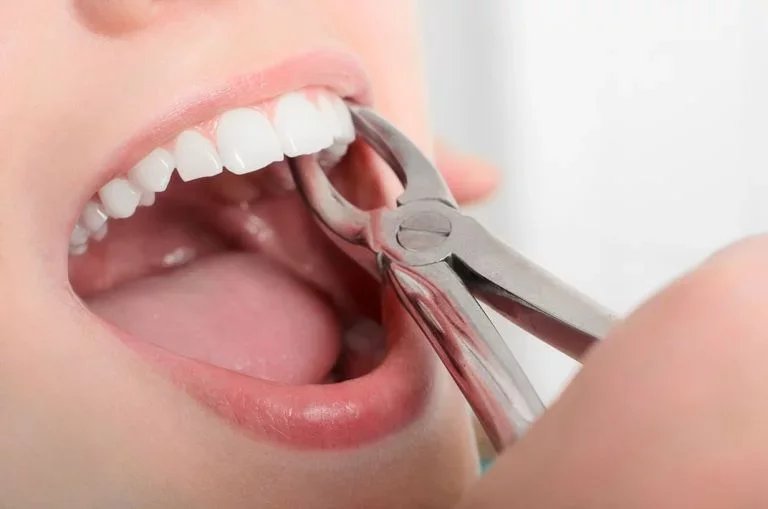
Extractions & Wisdom Teeth Removal
Comfortable, predictable oral surgery with sedation options included.
-
Wisdom teeth often cause problems long before pain develops. In fact, most issues happen quietly beneath the gums, without any warning signs. By the time pain appears, damage is usually already advanced.
Here are the most common silent problems caused by wisdom teeth:
1. Hidden Infection Around the Tooth (Pericoronitis)
Even partially erupted wisdom teeth leave small openings where bacteria collect deep under the gums.
This often leads to chronic low-grade infection that patients can’t feel, until it suddenly becomes severe.2. Cavities on the Tooth in Front (Second Molar Damage)
Wisdom teeth frequently press against the second molar, trapping bacteria and causing large cavities from the back side — a place impossible to clean.
By the time it hurts, it’s often too late and patients end up losing two teeth instead of one.
3. Cysts and Bone Damage
Impacted wisdom teeth can develop cysts (fluid-filled sacs) that slowly expand and cause:
Bone destruction
Root damage on nearby teeth
Facial or jaw structural changes
These form silently and are usually discovered on X-rays.
4. Gum Disease Around the Second Molar
Wisdom teeth are the #1 cause of gum disease behind the second molars in young adults.
This leads to:
Bone loss
Gum recession
Persistent inflammation
Removing the wisdom tooth stops the disease from progressing.
5. Future Surgical Difficulty Increases With Age
Removing wisdom teeth is simplest between ages 15 and 25 because:
The roots are not fully formed
The bone is softer
Healing is quicker
Complications are fewer
Waiting increases risk of:
Nerve irritation
Bone removal
Longer recovery
More swelling and pain
6. They Rarely Function as Useful Chewing Teeth
Even if they erupt fully, they sit far back and are very difficult to clean — leading to decay or infection later.
-
Simple Extractions Surgical / Complex Extractions
For broken, fragile, or heavily decayed teeth requiring sectioning or flap elevation.
Wisdom Teeth Removal
Including:
Full bony impactions
Partial impactions
Horizontal impactions
Soft tissue impactions
Urgent / Same-Day Extractions
For severe pain, infection, or fractured teeth.
-
IV Moderate Sedation
A fully monitored sedation where most patients:
Do not remember the procedure
Are comfortable and relaxed
Recover quickly
Deep Sedation (With an Anesthesiologist)
Provided when requested or medically appropriate.
This offers complete unconsciousness.Safety First
Sedation is monitored with:
Cardiac monitoring
Blood pressure
Oxygen saturation
Capnography
You are cared for by a trained surgical sedation team including registered nurses and anesthesiologist when deep sedation is selected.
Click here to read more about our sedation options.
-
Because each case depends on complexity, impaction type, and imaging, pricing varies. Most patients fall into the ranges below:
Simple Extraction: $300-$350
Surgical Extraction: $300–$350
Wisdom Teeth Removal: $350–$700 per tooth
IV Moderate Sedation Fee: $600-$800
IV Deep Sedation Fee: $800-$1100
Insurance coverage
Many plans cover part or all of surgical extractions.
We help you navigate benefits and provide detailed estimates beforehand. -
Does wisdom tooth surgery hurt?
With sedation and local anesthetic, most patients report minimal discomfort.How long does recovery take?
Usually 5-7 days for moderate impactions, longer for complex cases.Do all wisdom teeth need to be removed?
Not always — we evaluate your imaging and discuss options.Can I return to work or school after?
Most patients take 1–2 days off.Will I need someone to drive me?
Yes, if sedation is used.Do I need to fast? If sedation is used, you need to fast for 8 hours prior to the procedure.